If you’ve ever shopped for a trailer-mounted drilling rig—whether you’re a small-scale water well driller, a utility contractor working on ground source heat pump installations, or a mining outfit scouting for mineral deposits—you’ve probably found yourself asking a simple, high-stakes question: how much fuel does this thing actually burn? As a supplier who’s spent the last 12 years talking to drillers around the world, I can tell you this isn’t a one-size-fits-all number. Fuel consumption for a trailer-mounted drilling rig depends on a dozen variables, not just the size of the engine under your drill mast. Today, I want to break down what those variables are, how to calculate them for your specific work, and what you can expect when working with equipment built to balance power and efficiency, not just brute force. Trailer-mounted Drilling Rig
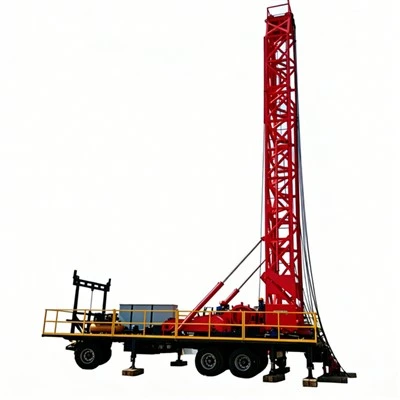
Let’s start with the basics. A trailer-mounted drilling rig is, at its core, a diesel-powered machine—almost always, because diesel engines hold up far better to the high-torque, continuous use drilling demands than gas or electric models do, especially when you’re working in remote areas with no grid power. But unlike a pickup truck or a semi, there’s no single “standard” trailer rig. A rig designed to drill 200 feet for a residential water well is tiny compared to one built to drill 1,500 feet for a commercial geothermal loop or core sample for mineral exploration. That size difference immediately changes fuel use. Let’s pull real, industry-average numbers from the rigs we build and the data we’ve collected from our customers over the last five years, because anecdotes don’t do anyone any good.
For light-duty trailer-mounted drilling rigs—think rigs with 50 to 150 horsepower engines, designed for residential water wells, shallow geothermal work, or small construction site sampling—fuel consumption typically lands between 1.5 and 3 gallons per hour (gph) of diesel when drilling consistently. That number jumps to 3 to 5 gph for mid-duty rigs: 150 to 300 horsepower, built for 500 to 1,200 foot wells, agricultural irrigation, or larger geothermal projects. Heavy-duty drilling rigs, with 300 to 500 horsepower engines, built for deep water wells, mining core samples, or directional drilling for oil and gas exploration, clock in at 5 to 9 gph of diesel during active drilling. But here’s the catch: those numbers only apply when the rig is actually drilling. If it’s just idling on site, waiting for permits, moving between holes, or setting up the mast, fuel use drops way down—usually less than 0.5 gph for light rigs, up to 2 gph for heavy rigs.
But if you stop there, you’re missing half the story. Those average gph numbers don’t account for the things that make or break your operating budget as a driller. Let’s talk about the biggest factors that shift fuel use, because this is where many new driller buyers get tripped up and end up with way higher fuel costs than they planned for.
First, drill depth and soil type. If you’re drilling through soft sand or loose topsoil, the drill bit cuts through material with very little resistance, so the engine doesn’t have to work hard. That’s when you’ll hit the lower end of your rig’s fuel range. Drill through solid granite, shale, or compacted clay, though, and the engine has to push the bit through far denser material, increasing torque demand and fuel use by 20 to 40% easily. I remember a customer in western Texas who bought a mid-duty rig to drill irrigation wells for a ranch, planning on 3 gph average. Half his jobs were through soft alluvial soil, but the other half were through hard limestone, and his average ended up closer to 4.2 gph. That’s a $200+ difference in fuel per week, just because of the rock he’s working through. Depth plays a part too: the deeper you go, the longer the drill string, the more weight pulling on the bit, and the more power the hydraulic system needs to keep the drill rotating and pulling up cuttings. A 1,000 foot well will burn 15 to 25% more fuel than a 500 foot well on the same rig, assuming similar soil.
Second, how you operate the rig. This might sound obvious, but you’d be shocked how many new drillers don’t realize that their own habits change fuel use more than most variables. A good driller learns to adjust their speed, torque, and weight on the bit to match the soil, instead of running the engine at full throttle the entire time. Our most efficient customers, the ones who consistently hit the lower end of their rig’s fuel range, take 5 to 10 minutes at the start of each hole to test the soil, adjust the bit, and fine-tune the engine settings instead of ramping up full power immediately. Conversely, drillers who rush through setups or overwork the engine by forcing a bit through material it’s not built for can add 30 to 50% extra fuel use without getting any more work done. I’ve also seen customers leave their rig idling all day between holes because they don’t want to shut down and restart the engine, not realizing that over 8 hours of idle time, that adds up to 4 gallons of fuel wasted—enough to drill an extra 20 feet on a light-duty rig.
Third, rig size and design. This is where working with a reputable supplier makes a huge difference. Not all 200 horsepower mid-duty rigs are built the same. At our company, we design our trailer-mounted rigs with what we call “load-matched engines”—engines that are sized exactly for the rig’s maximum drilling demand, not 50 horsepower oversize just to add a buffer that doesn’t actually help. A rig with an oversize engine will use more fuel at any given load, because it’s running at a lower torque range, which is less efficient for diesel engines. We also integrate variable hydraulic systems, so the pump only uses as much power as needed, not full power all the time, and automatic idle shutoff that kicks in if the rig is idling for more than 3 minutes, saving that unnecessary fuel. Cheaper rigs cut corners on these design features, so you might see a “200 horsepower rig” that burns 30% more fuel than ours because of a mismatched engine.
Fourth, auxiliary equipment use. Drillers don’t just run the drill mast, right? You’ve got mud pumps to circulate drilling fluid, compressors for air drilling, winches for pulling drill pipe, and lighting or power tools for your crew on site. All of these run off the rig’s engine, either through hydraulic power take-offs (PTOs) or direct drives. If you run a mud pump at full speed the entire time you’re drilling, that can add 1 to 2 gph to your fuel use, depending on the pump size. Even running a small air compressor for bit cleaning can add 0.5 gph. We often advise our customers to size their auxiliary equipment to match their rig, not the other way around, because adding a bigger pump than you need just to handle future jobs means burning extra fuel every single day.
Now, let’s put this all together with a real-world example that’s not pulled out of thin air. Last year, we sold a mid-duty trailer-mounted drilling rig to a geothermal contractor in Ohio who does residential closed-loop installations. His average job is 400 feet of horizontal drilling through glacial till and soft limestone, with occasional shots of harder dolomite. His daily drilling time is about 6 hours, with 2 hours of setup, idle, and travel between sites. Using our fuel calculator, which factors in his typical soil, job size, and auxiliary equipment use, we projected his average fuel use would be 3.7 gph. At $3.50 per gallon of diesel, that works out to about $77.70 per day in fuel. A year later, he came back to buy a second rig, and told us his actual average was 3.65 gph—almost exactly what we projected. That’s not luck; that’s accounting for all the variables, and working with a rig designed to be efficient for real-world drilling, not just test conditions.
I also want to address a common myth I hear all the time: that bigger rigs are always less fuel-efficient per foot drilled. That’s not true, but it depends on the job. A light-duty rig drilling a 200 foot well through soft sand might burn 1.8 gph, so per foot, that’s about $0.14 per foot. A mid-duty rig drilling a 200 foot well through hard limestone might burn 4.5 gph, so about $0.35 per foot. The bigger rig burns more total fuel, but it also drills that well 3 times faster than the small rig, so total time is shorter, and per-foot cost is actually lower. That’s why it’s so important to match your rig size to your typical jobs, instead of buying the biggest rig you can afford just in case. If you never drill deeper than 500 feet, a heavy-duty rig is going to cost you way more in fuel and maintenance than a mid-duty one, even if you only use its full power occasionally.
Now, what can you do to lower your fuel consumption, no matter what rig you’re running? First, keep up with regular maintenance. A dirty air filter, clogged fuel injectors, or worn drill bits can increase fuel use by 10 to 20% without you noticing. We recommend changing the fuel filter every 100 operating hours, checking the air filter every 50 hours, and replacing drill bits when they show even minor wear—blunt bits force the engine to work 20% harder to cut through the same material. Second, optimize your operation. Take the time to test soil before drilling, adjust torque and speed to match conditions, and use the auto-idle feature if your rig has it, or manually shut down the engine when you’re waiting more than 5 minutes. Third, work with a supplier that gives you clear, realistic fuel estimates, not just a one-size-fits-all number. A good supplier will ask about your typical job size, soil type, and auxiliary equipment, and give you a custom projection, not a generic stat pulled from a brochure.
At the end of the day, fuel consumption isn’t just a number on a spec sheet—it’s a direct line to your profit margin. For a small driller doing 10 wells a month, cutting fuel use by just 0.5 gph can save you over $5,000 a year. For a larger outfit drilling hundreds of feet a week, that same 0.5 gph can add up to tens of thousands in savings. If you’re in the market for a new trailer-mounted drilling rig, or you’re looking to upgrade your current setup to lower fuel costs, we’re here to help. We don’t just sell equipment—we work with drillers to understand their specific jobs, their budget, and their long-term goals, so you can choose a rig that’s powerful enough for your work, but efficient enough to keep your operating costs low. Whether you’re drilling residential water wells, geothermal loops, or mineral core samples, we can give you the real, data-backed fuel estimates you need to make the right choice for your business.
Don’t guess at your drilling rig’s fuel needs—get the facts from an industry supplier that’s on the job sites with you every day. Contact our team today to discuss your requirements and get a custom evaluation that fits your work and your budget.
Mud Pump References
- American Drillers Association. (2022). 2022 Trailer-Mounted Drilling Rig Fuel Efficiency Report. National Drilling Association Publications.
- Energy Information Administration. (2023). Diesel Fuel Use in Construction and Drilling Equipment. U.S. Department of Energy.
- International Organization for Standardization. (2021). ISO 10446:2021, Earth-Moving Machinery—Fuel Consumption Measurement and Calculation Method.
- Drilling Contractors Association of North America. (2022). Best Practices for Reducing Drilling Rig Fuel and Operational Costs. Annual Industry Whitepaper.
Hebei Zhongxin Machinery Equipment Co., Ltd.
As one of the most experienced trailer-mounted drilling rig manufacturers in China, we also support customized service. We warmly welcome you to buy high quality trailer-mounted drilling rig for sale here from our factory. If you have any enquiry about pricelist, please feel free to email us.
Address: Wangxizhang Industrial Zone, Zhao County, Shijiazhuang City, Hebei Province, China
E-mail: zxnjbzg@163.com
WebSite: https://www.hbzxdrilling.com/
